


When Life Touches Death: Yeshua and the Reversal of Ritual Impurity

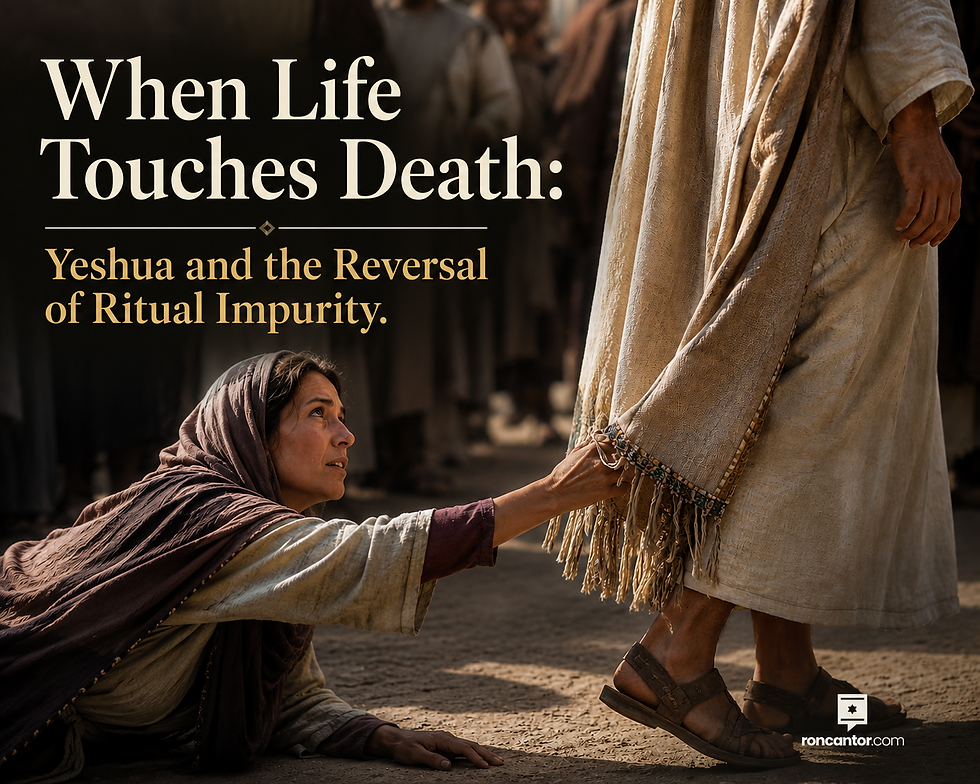
In Matthew 8, within the span of a single chapter, Yeshua does something that would have made every observant Jew in the crowd catch their breath. He touches a man with tzara'at (often translated as “leprosy”). He takes the hand of a dead girl. And a hemorrhaging woman grabs the fringes of his garment. Three encounters. Three sources of ritual impurity. And Jesus doesn't flinch once.
To understand why this is so remarkable—and what it actually means—we have to understand ritual purity in Second Temple Judaism.
Unclean Does Not Mean Sinful
This is the first thing to get right, because centuries of Christian misreading have badly distorted the picture. Being in a state of ritual impurity (tumah) was not a moral failure. It was not evidence of sin. Jen Rosner helpfully clarifies that impurity was simply a condition resolved through “washing and waiting” (Finding Messiah, p. 49). You buried your father—you became unclean. Your wife gave birth—she became unclean. A skin condition flared up—unclean. None of these carried moral guilt. They simply created a temporary barrier to the individual's participation in sacred space and communal worship.
Matthew Thiessen, in his work on Jesus and the purity system, emphasizes that the Torah's impurity laws were not arbitrary or primitive. They formed a coherent symbolic world that kept Israel perpetually oriented toward one central truth: God is holy, and approaching Him requires preparation. Every time a Jewish man or woman navigated the requirements of purity—avoiding contact with a corpse, checking skin conditions, observing the rituals of purification—they were being trained in the grammar of holiness. The system functioned as a constant, lived reminder that the God of Israel was not like the gods of the nations. He was kadosh—set apart, other, holy.
A Torah-Observant Jesus
This makes what Jesus does in Matthew 8 even more striking—not less. He was not some freewheeling revolutionary who discarded Jewish practice. He wore tzitzit, the ritual fringes commanded in Numbers 15 for every Jewish man, fringes that were long enough for the hemorrhaging woman to grab as he passed through the crowd (Matthew 9:20). He engaged the Temple system, instructed the leper he healed to show himself to the priest and offer the gift Moses commanded (Matthew 8:4). He did not come to abolish the Torah but to fulfill it (Matthew 5:17).
So what is happening when he touches the untouchable?
The Reversal of the Curse
The conventional explanation, popular in certain theological traditions, is that Jesus is signaling the end of the purity laws—that the old categories no longer apply and the kingdom he brings has dissolved the boundary between clean and unclean. But this misses something far more profound.
Thiessen argues that Jesus does not absorb impurity the way ordinary Israelites would. In every other instance in Torah, impurity flows outward: you touch a corpse, you become unclean. The direction of transmission is fixed. But with Yeshua, who is One with the Father, something different happens.
When he touches the leper, the leper is the one made clean—Yeshua is not made unclean.
When he takes the hand of Jairus's daughter, death does not contaminate him—she is raised.
When the woman touches his fringe, rather than her uncleanness transferring to him, healing flows out from him to her.
The direction reverses. Purity—life—flows from Jesus outward.
This is not the abrogation of the purity system. It is its eschatological fulfillment. Jesus is not saying the laws were wrong. He is demonstrating what happens when the Author of Life enters the story in person.
Why Could Yeshua Do This?
The answer is in who he is. Yeshua is not merely a rabbi with exceptional compassion, though he is that. He is the one Isaiah foretold, who would bear our griefs and carry our sicknesses (Isaiah 53:4, quoted by Matthew in 8:17). He is the resurrection and the life (John 11:25). He is, in the language of John's prologue, the Word through whom all things were made—including the very life-force that death and disease attack.
When Life itself walks into a room where a corpse lies, what can death do? When the Healer of all flesh extends his hand toward a man consumed by skin disease, where does the power run? The purity laws existed, in part, because fallen humanity is downstream from death. We are susceptible. We are fragile. We carry the contamination of a world under the curse, and the laws of purity acknowledge that reality honestly.
But Yeshua came to reverse the curse—not by ignoring it, but by absorbing and defeating it from within. He didn't stand at a distance and declare people clean. He reached out and touched them because his touch carried more power than death could withstand.
What This Means for Us
The purity system did its job. It taught Israel for centuries that God is holy and humanity is not—not in our own strength, not on our own terms. “Washing and waiting” was never the final word. It pointed forward to the One who would make all things new, who would one day speak of living water (John 4), whose blood would purify the conscience (Hebrews 9:14).
Yeshua didn't come to make the purity laws irrelevant. He came to make them complete.
And for everyone that system once kept at arm's length—the sick, the bereaved, the chronically ill—he walked straight toward them. Because that's what Life does when it enters a world that has forgotten how to live.
Rosner writes:
“As demonstrated by his life and ministry, Jesus embodies more of the divine presence than any other human being, which is made especially evident through the invasive quality of his holiness. While contact with ritually unclean objects and persons threatened to defile Israel’s holiness, Jesus’ holiness flows outward into the impure world. Through him, the holiness embodied by Israel begins to ripple throughout creation, as it was always intended to do.”
That’s the shift the purity system was always aiming at. Uncleanness used to be contagious; now holiness is. Yeshua didn’t lower the bar on purity—he became the source that raises everyone who touches him.


One of the best articles I've read maybe in my entire life. I was emotional at times as I read through it. It clarifies and gives new meaning to a lot of concepts I knew about.