


Is Jesus Still Jewish? 17 Verses Responding to Dale Partridge


Pseudo-pastor and race-baiter Dale Partridge (I’m honestly not sure if he is a born-again, regenerated follower of Jesus because of the hate he spreads against women, Blacks, and Jews). Like his hyper-reform brothers JD Hall and Joel Webbon — the latter of whom has said Jews should be barred from public office and has described Jewish people as “generally marked by subversion, deceit, and greed” — Partridge has a history of dishonesty. His plagiarism is detailed in this article and this one.
Partridge has taught that Black people, citing Noah’s curse in Genesis 9, are the modern descendants of Ham, divinely assigned to what he calls a “civilizational station of subordination and dependence,” ruled over by whites, Europeans, Asians, Jews, and Arabs — and he has called for a return to European colonization of Africa.[1]
Today, he posted that the Ten Commandments are not Jewish.
“The Ten Commandments are not Jewish. The Old Testament is not Jewish. The entire Bible is Christian. Genesis to Revelation is all about Christ.”
He’s not only stating opinions (not facts), but he is also seeking to demonize the Jewish people. Isn’t he going to be shocked to find out that Christ is still Jewish? Messiah came into this world a Jew, and after rising from the dead had the same physical body — ask Thomas.
Here are 17 verses that not only confirm that Jesus is Jewish, but that His coming kingdom will reign from Jerusalem. The nations will worship Him there (Zechariah 14:16).
Tier 1: Post-Resurrection Self-Identification
Jesus’s own words and actions immediately after rising, showing He continued to identify within a Jewish framework
1. Luke 24:19-27 — On the Emmaus road, the risen Jesus interprets His own identity entirely through “Moses and all the Prophets” — no new framework, just the existing Hebrew Scriptures.
2. Luke 24:44-47 — He tells the disciples that everything about Him is written in “the Law of Moses and the Prophets and the Psalms” — the full Tanakh structure (Torah, Nevi’im, Ketuvim).
3. John 20:17 — To Mary Magdalene: “My Father and your Father, to My God and your God” — Jewish covenantal language, still explicitly His God after rising. Yeshua is placing his own relationship to God inside the same covenant relationship the disciples (Jewish disciples) have to God. He’s not claiming a private, new deity or a post-Jewish Father-concept; he’s using the shared covenantal “your God” formula (echoing texts like Exodus 6:7, “I will be your God”) and explicitly extending it to include Himself alongside them, post-resurrection.
4. John 20:19, 26 — Appearances dated by Jewish reckoning (“the first day of the week”), in a Jewish social and religious context.
5. Luke 24:30 — At Emmaus, He takes bread and blesses it before breaking it — a recognizably Jewish table practice. He is still living as a Jew.
6. Acts 1:3 — Forty days after his suffering, He speaks of “the kingdom of God” — an Israel-centered, prophetic concept, not a Gentile replacement idea.
7. Acts 1:6-7 — Disciples ask if He will “restore the kingdom to Israel”; He corrects only the timing, not the premise. He indicates that after the gospel goes to the whole world, the kingdom will be restored to Israel in its fullness—just as the prophets declared. The added revelation is that the Gentile believers become co-heirs with Israel.
Tier 2: NT-Applied Messianic Prophecy
Old Testament texts the New Testament explicitly ties to the resurrection or Jesus’s identity as Messiah
8. Romans 1:3 — “regarding his Son, who, as to his earthly life, was a descendant of David.” While the verb here is in the past tense, referring to Jesus’ earthly life, we will see that he continues to self-identify with David.
9. Psalm 2:7 — “You are my Son, today I have begotten you” — applied directly to the resurrection in Acts 13:33 and Hebrews 1:5.
10. Acts 26:22-23 — Paul testifies that he proclaims “nothing but what the prophets and Moses said would come to pass” — that the Messiah would suffer, rise first from the dead, and proclaim light “both to our people and to the Gentiles,” naming Israel first in the resurrected Messiah’s mission.
11. Revelation 5:5 — One of the elders tells John that Jesus is “the Lion of the tribe of Judah, the Root of David.” Scholar Louis Brighton, in his commentary on Revelation, emphasizes that these are distinctly Jewish messianic titles rooted in prophecy and Jewish expectation. The significance is that even in the heavenly vision—decades after the resurrection—Jesus is still identified by his Jewish lineage and role.[2]
Tier 3: OT King/Zion Prophecy
Texts pointing to where that identity is heading — still anchored to Israel and Jerusalem, not away from them
12. Zechariah 14:4 — His feet stand on the Mount of Olives — the same site of the ascension in Acts 1:11-12. And let’s not forget the angel’s words to the stunned disciples: “Jesus … will come back in the same way you have seen Him go into heaven,” connecting him to Yahweh of Zechariah 14.
13. Zechariah 14:9 — “The LORD will be king over all the earth... the LORD will be one and His name one” — tied to Israel’s covenant Name, not a new deity. Whenever you see LORD in all caps like this, it is telling you that it is not the generic word for Lord Adoni, but the specific name of God, Yahweh.
14. Zechariah 14:16-19 — The nations keep the Feast of Booths (Sukkot) after his coming — a Jewish festival, not a replaced practice. Jesus alludes to this in the account of the sheep (not the goats) gathering before his throne in Jerusalem (Matt. 25)
15. Isaiah 2:3 — “Out of Zion shall go forth the law, and the word of the LORD from Jerusalem” — the source of end-time authority stays in Zion.
16. Psalm 2:6 — “I have set my King on Zion, my holy hill” — God’s king is installed specifically on Zion.
17. Psalm 2:8-9 — The Son inherits the nations and rules “with a rod of iron” — reign radiates from Zion outward, not away from it.
Three lines of evidence, three different moments in the story, one consistent answer. In the hours after the resurrection, Jesus doesn’t announce a new religion — He opens the Hebrew Scriptures and shows the disciples that His death and rising were there all along (Tier 1). Decades later, when the apostles preach and John receives his vision on Patmos, the language they reach for is still David’s line, still the tribe of Judah, still the promises given to Israel (Tier 2). And the story doesn’t end with the resurrection or the ascension — it ends with a King who returns to the same Mount of Olives He left from, to reign from the same Zion the prophets named centuries before (Tier 3). The risen Messiah, the ascended Messiah, and the returning King are not three different figures with three different identities — they’re the same Jewish Messiah, recognizable at every stage because He never stopped being who He always was.
That’s the problem with Partridge’s claim. If the Ten Commandments, the Old Testament, and the Jewish Messiah himself can be quietly detached from the Jewish people who received them and gave birth to Him, then the very Scriptures Partridge claims are “all about Christ” stop making sense — because the Christ they’re about never stopped being a Jew.
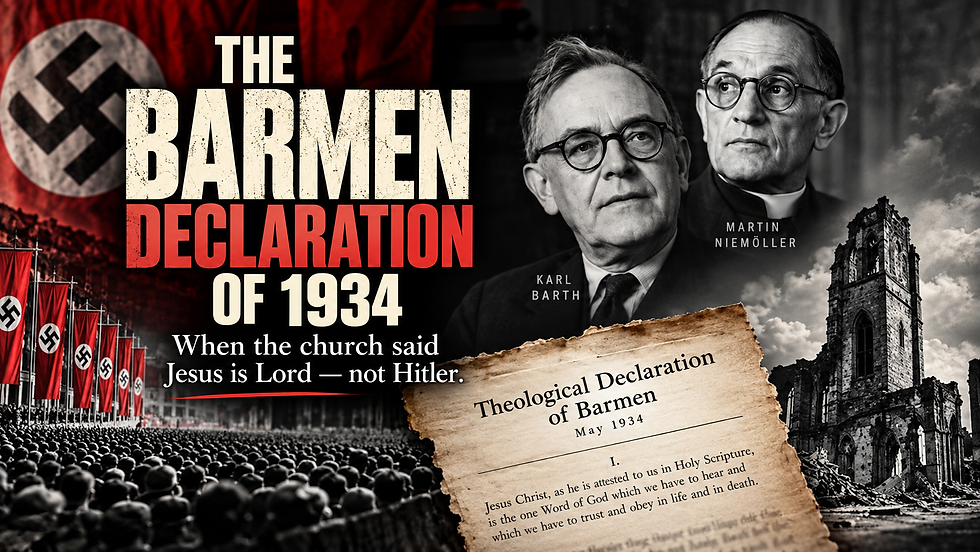
This isn’t a new argument, and it isn’t harmless. Nazi Germany ran its own version of this project — the “German Christians” movement taught that Jesus was Aryan, not Jewish, and an official Nazi-backed institute published a Bible with the Jewishness edited out. Severing Jesus from his Jewish identity has never remained theoretical. It has been the theology that made room for the violence that followed. Partridge and his friends are walking a road that’s been walked before, and it didn’t end well the last time either.
You cannot keep the Messiah and discard the people He came from, rose as, ascended as, and will return as. Take away Jesus’s Jewishness, and there are no Ten Commandments, no Hebrew Bible, and no returning King left to write about. Erasing the Bible’s author’s identity is very close to changing Scripture itself. Sadly, I don’t expect Dale Partridge to heed this. But truthfully, I didn’t write it for him. I wrote it for you — so that when someone tries to tell you Jesus was never really a Jew, you’ll know exactly where to turn.
[1] Genesis 9 curses Canaan specifically — not Ham’s other sons Cush, Mizraim, or Put, whose descendants are the ones traditionally linked to Africa — and Canaan’s line settled in the land of Canaan (modern Israel/Lebanon/Palestine), not sub-Saharan Africa, so the “Curse of Ham” applied to Black people rests on a double misidentification the text itself doesn’t support. And even setting that aside, Ezekiel 18:20 explicitly rejects the idea that a son bears guilt for an ancestor’s sin, which cuts the legs out from under any claim that a curse from Noah’s day still binds anyone today.
[2] Louis A. Brighton, Revelation, Concordia Commentary (St. Louis, MO: Concordia Pub. House, 1999), 136.



Comments