


Israelis Subdue Attacker on Flight to Tel Aviv—“Three or four people saved 180 lives.”

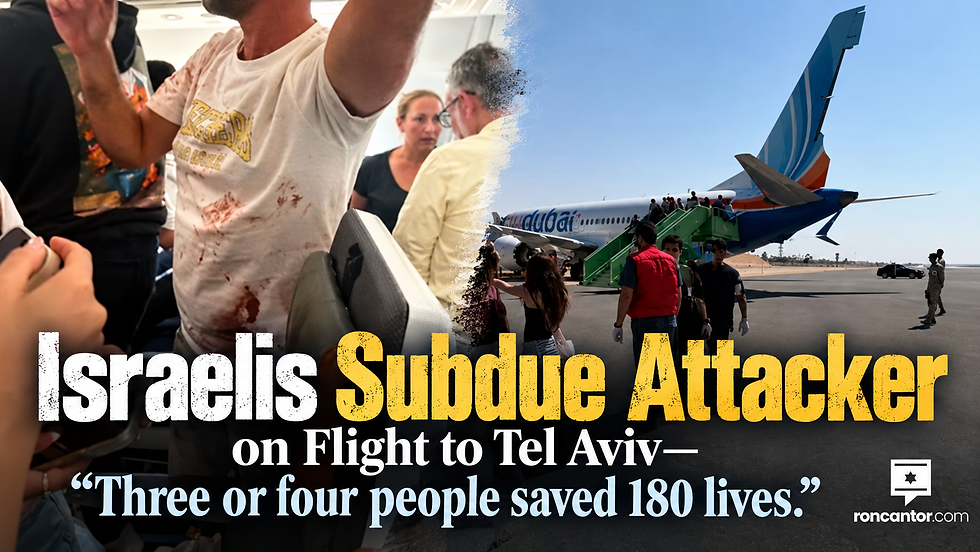
A flydubai flight from Dubai to Tel Aviv made an emergency landing in Saudi Arabia on Wednesday after a violent struggle in the cockpit, and passengers say a small group of Israelis on board stepped in, subdued the attacker, and stabilized the aircraft. No passengers were reported seriously hurt, although there is a photo circulating of an Israeli with significant blood on his shirt.
According to Hebrew media accounts cited by The Times of Israel, the flight's copilot, an Omani national, appeared to have stabbed the captain, an Emirati, at which point the Boeing 737 MAX lost control. Israeli passengers then stormed the cockpit. About an hour later, the plane landed at Tabuk airport in Saudi Arabia. The captain was reported to be seriously wounded and was taken for treatment.
Israel has an agreement with the UAE that all pilots must be from a country that is part of the Abraham Accords. Oman is not. This is a serious violation.
A plunge, then a struggle for control
Flight-tracking data showed the aircraft climbing to 34,000 feet before dropping to roughly 17,000 feet in under a minute about two hours and fifteen minutes into the journey, while its speed climbed from 411 knots to nearly 600. After a brief recovery, it fell again to just under 15,000 feet and held near that altitude for about an hour, a pattern that suggests the plane was being flown by hand rather than on autopilot.
The aircraft first transmitted the international emergency code 7700, then 7500, which signals a hijacking or unlawful interference, before returning to 7700 on approach to Tabuk. Israeli Air Force jets were scrambled, and Prime Minister Benjamin Netanyahu and Defense Minister Israel Katz held emergency consultations. Images from the ground appear to show damage to the plane’s rudder.

(LEFT - Israeli on the plane, with blood on his shirt.
RIGHT - The plane's rudder appears damaged. Photos: Twitter)
“We subdued him.”
Videos filmed on board show the captain bloodied on the floor outside the cockpit as passengers tended to him, with a second crew member bound beside him. “We were attacked and are guarding the pilot,” one passenger told the person filming. A passenger named Adam told Channel 13 that “three or four people saved 180 lives.” Another told Channel 12 that passengers recited the Shema prayer and, at moments, believed they would not survive.
When the plane touched down, footage that The Times of Israel could not independently verify appeared to show passengers clapping and singing.
Survivors: “It felt like an eternity”
Passengers interviewed by Israeli media described minutes of terror as the aircraft dove. “The spinning stopped. It took some — I don’t know, it felt like an eternity, but I think it was two minutes, at least two or three minutes, during which the plane was simply diving and spinning like crazy. It felt like, that’s it. It’s over. September 11 is happening again,” a passenger named Daniel told Channel 12.
Daniel credited the men who intervened: “Those three Israeli guys are real heroes. It’s hard to explain just how heroic they were.” Another Israeli passenger told The Jerusalem Post, “I shouted at them to run and take control of the plane.”
Relatives passed on accounts as well. Yasmin Abu Kasis, whose daughter Miriam was aboard, said in remarks carried by Reuters that her daughter had heard screaming and that “a man took a knife, put the pilot on the floor.” That is a secondhand account, and investigators have not confirmed the details.
Calm under pressure
Reports so far do not say who the passengers were who entered the cockpit or what their backgrounds are, but many Israelis will recognize the composure described in the accounts. Israel has near-universal military service, and generations of Israelis have been trained in the IDF to make decisions quickly, work together, and keep a clear head when the situation is at its worst. That culture of readiness is part of ordinary life in Israel, and it is a plausible reason the response on board was so fast and coordinated.
The passenger who joked in a video that he needed to change out of his blood-soaked clothes once the danger had passed offered a small illustration of the same temperament. The same sent a video to his children saying, “You have a father who is a hero,” adding, “one of the heroes,” giving credit to the others.
The trip home, and those who hesitated
Later in the afternoon, Tabuk airport announced that both the captain and the copilot had been found with injuries and taken to hospital, and that it was coordinating with flydubai on a replacement aircraft. One passenger told Israeli media the Saudi authorities were treating the travelers well. The Times of Israel then reported that a flydubai plane had landed at Tabuk to pick up the stranded passengers, most of them were Israeli, and that they were beginning to board for the flight to Israel.
Not everyone was eager to get back on a flydubai plane. Channel 12, citing a passenger, reported that some of the Israelis were uncomfortable flying with the same airline and preferred to wait for an Israeli carrier, and that the rescue plane had not yet departed while they weighed their options. The same passenger said no Israeli official had reached out to the passengers.
What is still unknown
The picture has shifted through the day. When I woke up this morning, Israeli security sources said a hijacking had been ruled out and described an altercation between the pilots. Then, I read that the rudder was damaged.
Later reports, including one in The Jerusalem Post citing Israeli officials, said the copilot, believed to be an Omani national, had tried to hijack or crash the plane, and one official said a “major disaster was narrowly avoided.”
Israeli officials were still unsure of the aim, and other possibilities, including a mental health episode unrelated to any political motive, were also being examined. Mossad, the Shin Bet, the IDF and the Transportation Ministry are all involved in the investigation. Flydubai has said only that its teams are “working closely with the relevant authorities.” As of the latest reports, neither Saudi nor Emirati authorities had publicly explained a motive, and the copilot’s condition had not been officially described.
A backdrop of rising antisemitism
Whatever the investigation finds about motive, the episode arrives at a tense moment for Jews and Israelis abroad. On the same day, the Community Security Trust reported a 14 percent rise in antisemitic incidents on British university campuses in the 2025–26 academic year, and warned that universities must do more to protect Jewish students and staff. Jewish organizations in the United States have also been debating how city and campus initiatives should address hostility toward Israel.
It is important to separate what is known from what is not. Nothing reported so far establishes that this attack was motivated by antisemitism, and it should not be described that way unless investigators say so. But the worldwide increase in hostility toward Jews is the context in which Israelis now travel, and it is the lens through which passengers themselves described the ordeal.
Families had gathered at Ben Gurion Airport hours earlier, waiting for word. The investigation is continuing, and details may change.




Comments