


09 / The Martin Luther You May Not Know: "On the Jews and Their Lies" (1543)


Martin Luther is remembered by many Christians as a courageous reformer who challenged corruption within the medieval Church and helped return the Bible to ordinary believers. His insistence that Scripture should be accessible to the common person transformed European Christianity and helped spark the Protestant Reformation. His contribution to evangelical orthodoxy cannot be underestimated. But later in life, a darker image emerged.
Reminder: Why we are writing these stories
Before we continue, I want to remind people why we are sharing these stories. The relative favor that Jewish people have received in the Western Hemisphere since the Holocaust has been an aberration in history, not the norm. Recently, the number one podcast in America sparked outrage by claiming “You murdered 3,000 Americans on 9/11,” referring to Israel and referring to Israel as “satanic pedophiles.” Whatever you might think about this podcaster, she is reaching millions of people with hate. Jesus will return, according to Zechariah 14, to Israel under attack. He will fight for her, defend her, and set up his kingdom. I do not believe he returns for an antisemitic Bride.
Back to Luther: Later in life, he wrote words about the Jewish people that would become some of the most troubling and influential anti-Jewish writings in Christian history.
Kindness, Frustration, Hatred
In 1543, Luther published a treatise titled On the Jews and Their Lies. By this point, he was an elderly man, frustrated that Jewish communities had not embraced his understanding of the gospel. Early in his career, Luther had hoped that reforming Christianity—removing abuses and clarifying the message of salvation—might make the faith more attractive to Jews. In a 1523 work titled That Jesus Christ Was Born a Jew, he even urged Christians to treat Jews kindly, believing that harsh treatment had been a major obstacle to Jewish conversion, writing, “We ought not to treat the Jews in so unkindly a spirit, for there are future Christians among them.”
He had harsh words for the Church in regard to its witness toward the Jewish people:
“If I had been a Jew and had seen such dolts and blockheads govern and teach the Christian faith, I would sooner have become a hog than a Christian. They have dealt with the Jews as if they were dogs rather than human beings. … If the apostles, who also were Jews, had dealt with us Gentiles as we Gentiles deal with the Jews, there would never have been a Christian among the Gentiles.”
Two decades later, however, Luther’s tone changed dramatically.
In On the Jews and Their Lies, Luther portrayed Jews not merely as people who rejected Jesus but as dangerous enemies of Christian society. He repeated many of the theological accusations that had circulated in Christian Europe for centuries—claims that Jews were stubborn, deceitful, and spiritually blind. More troubling still, Luther proposed a series of harsh measures against Jewish communities.
Theological Dehumanization
Among his recommendations were the destruction of synagogues, the confiscation of Jewish books, restrictions on Jewish teaching, the prohibition of rabbis from preaching, and the seizure of Jewish property. He also suggested forcing Jews into manual labor and expelling them from Christian lands if they refused to convert. These proposals were not unique to Luther—similar policies had been enacted at various times in medieval Europe—but his stature as a major Christian reformer gave them enormous weight.
“First, to set fire to their synagogues or schools… Second, I advise that their houses also be razed and destroyed… Third, I advise that all their prayer books and Talmudic writings… be taken from them… Fourth, I advise that their rabbis be forbidden to teach… Fifth, I advise that safe-conduct on the highways be abolished completely for the Jews… Sixth, I advise that usury be prohibited… Seventh, let the young strong Jews and Jewesses be given the flail, the ax, the hoe, the spade… and let them earn their bread in the sweat of their brow… We ought to drive the rascally lazy bones out of our system.”— Martin Luther, On the Jews and Their Lies (1543)
For centuries afterward, Luther’s harsh rhetoric was quoted by those seeking religious justification for anti-Jewish policies. In later European history, antisemitic writers frequently cited his words to support hostility toward Jewish communities. The fact that such language came from one of Protestantism’s most influential figures made it especially powerful.
It is important to understand the historical context of Luther’s writing. Sixteenth-century Europe was a deeply religious society in which theological disagreements were often expressed in severe and polemical (bold and outspoken) language. Jews lived as small minority communities across Christian lands and were frequently the targets of suspicion and discrimination long before Luther wrote his treatise. His work did not create Christian anti-Judaism, but it reinforced and amplified patterns that had already existed for centuries.
At the same time, Luther’s words illustrate how theological frustration can turn into hostility when faith becomes entangled with political power and cultural identity. Instead of viewing Jewish unbelief as a matter for persuasion and witness, Luther increasingly treated it as a social threat requiring coercion and exclusion.
A Fan in Adolf
In a chilling historical irony, the Nazi pogrom known as Kristallnacht began on the night of November 9–10, 1938, which fell on Martin Luther’s birthday. Nazi propagandists openly highlighted the coincidence. In 1933 there is a famous poster with Luther’s picture and the words: “Hitler's fight and Luther's teaching are the best defense for the German people.”

Newspapers and speeches pointed out that synagogues were burning on the birthday of Germany’s great reformer—suggesting that the violence was a fulfillment of Luther’s own recommendations in his 1543 book On the Jews and Their Lies, where he called for synagogues to be destroyed and Jews driven from society.
Adolf Hitler himself frequently praised Luther as a great German hero and cited his writings as evidence that hostility toward Jews had deep roots in German Christian history.
“Martin Luther has been the greatest encouragement of my life. Luther was a great man. He was a giant. With one blow he heralded the coming of the new dawn and the new age. He saw clearly that the Jews need to be destroyed, and we’re only beginning to see that we need to carry this work on.”
Nazi writers and pastors sympathetic to the regime quoted Luther to justify antisemitic policies, presenting them not as radical innovations but as a continuation of a long tradition. Luther’s words, which some argue were more polemic than sadistic, were repurposed nearly four hundred years later to legitimize violence against Jewish communities across Germany.
That approach stands in tension with the example of the earliest followers of Jesus. The New Testament describes the gospel spreading first among Jewish communities, with thousands of Jews believing in Yeshua in Jerusalem and beyond. The apostles themselves were Jewish, and the early movement saw itself not as replacing Israel but as proclaiming Israel’s Messiah.
For Christians today, Luther’s writings present a sobering reminder that even influential leaders can speak in ways that contradict the spirit of the message they proclaim. Recognizing this does not erase Luther’s role in the Reformation, but it does require honesty about the harm his later words caused.
Remembering this history is not about condemning people who lived centuries ago. It is about understanding how powerful religious voices can shape attitudes toward minorities—and how rhetoric, once spoken, can echo through generations.
The tragedy is that language intended to defend the faith sometimes helped justify persecution instead. When Christians look back at Luther’s On the Jews and Their Lies, they are confronted with a warning: zeal for theological truth must never become an excuse for hatred or violence.
History shows what can happen when it does.

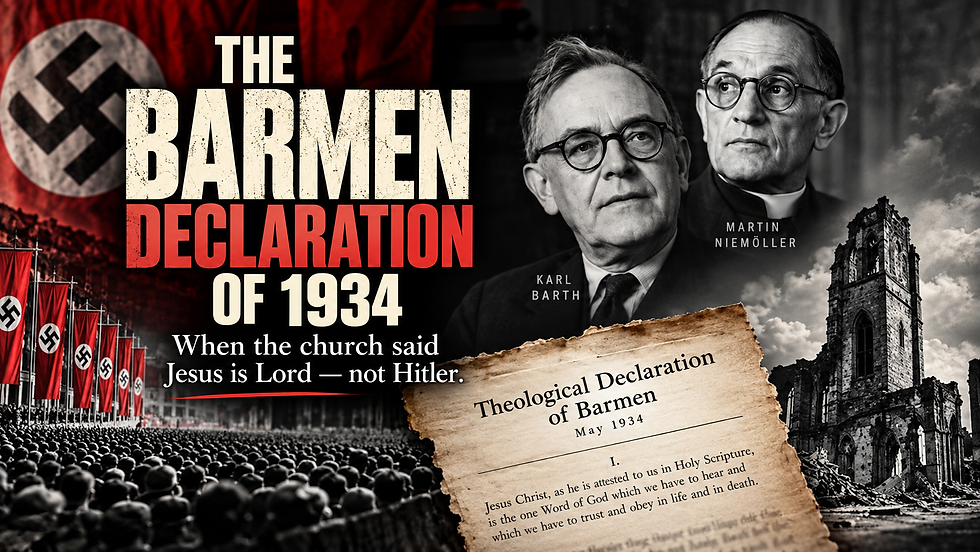


Empires have official religions. It establishes cohesion among the populace. Everyone's allegiance to the state is ensured by it. At one stage emperor worship was the factor that proved one's loyalty to the Roman Empire. In Luther's time babies were registered by the official churches in the states of Europe when they were Christened/"baptised".
A citizen of these countries was regarded as a Christian, having been initiated into the Church by this ritual. Some modern preachers seem to be ignorant of this form of "Christian Nationalism". Jews were not regarded as proper citizens. The Baptists, who were contemptuously named Anabaptists, broke away from this church-state model. They were maligned by Luther and fiercely persecuted all over Europe. God never claimed…