


Part 1: Judge Not? What Jesus Actually Said

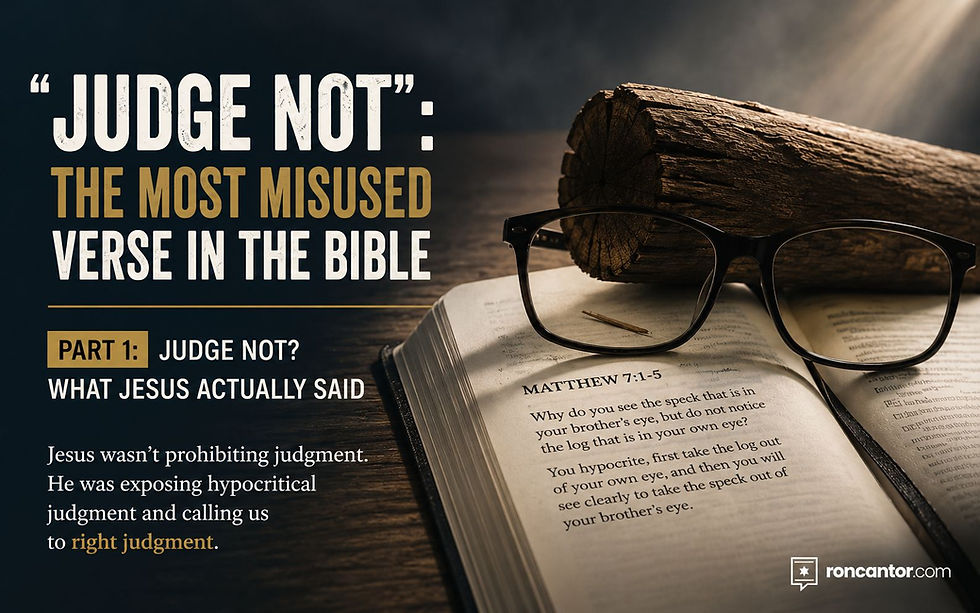
Today's blog is Part One of three blogs on judging in the New Testament:
Part 1 — Judge Not? What Jesus Actually Said
Part 2 — Paul and the Responsibility to Judge Inside the Church
Part 3 — Judging the Tree: What Fruit Actually Means
Part 1: Judge Not? What Jesus Actually Said
The Verse Everyone Knows and Almost No One Finishes
Few verses are more frequently misquoted — and more conveniently misapplied — than Matthew 7:1: “Judge not, that you be not judged.” Pulled from its context and deployed as a conversation-stopper, it has become one of the most powerful silencing tools in modern Christian culture. Mention a pastor’s moral failure, question a leader’s words of repentance versus his actions (or lack thereof), or raise concerns about abuse being covered up in a church, and someone will invariably reach for this verse like a shield. The message is clear:
True followers of the Messiah don’t judge.
Discernment is arrogance.
Accountability is Pharisaism.
Back off and let God handle it. If he wants to remove a leader, he can. It’s not your business.
There is only one problem with that interpretation. It isn’t what Jesus said.
Lesson One: Keep Reading!
To understand what Jesus actually meant, we have to do something shockingly simple: keep reading. Matthew 7:1 does not exist in isolation. One of the first things they teach you in seminary is how to read a verse in context, because context is everything.
It opens a passage — a coherent, extended teaching — and if we stop at the first verse, we have not only missed the point, we have inverted it. Jesus was not issuing a prohibition against moral evaluation. He was issuing a warning against a specific and poisonous kind of judging: the judging of the hypocrite.
The passage continues in verses 2 through 5:
“For with the judgment you pronounce you will be judged, and with the measure you use it will be measured to you. Why do you see the speck that is in your brother’s eye, but do not notice the log that is in your own eye? Or how can you say to your brother, ‘Let me take the speck out of your eye,’ when there is the log in your own eye? You hypocrite, first take the log out of your own eye, and then you will see clearly to take the speck out of your brother’s eye.”
Notice the structure of this teaching carefully. Jesus introduces a problem — hypocritical judgment — and then he describes it with a vivid, almost comic image: a person with a massive plank lodged in their own eye, squinting to identify a tiny splinter in someone else’s. The absurdity is the point. This isn’t about whether you should examine your brother’s eye. It’s about the fact that you cannot do it well while your own vision is catastrophically impaired by your own sin.
The log is not merely a symbol of moral failure. It is a symbol of a particular kind of blindness — the blindness of the person who has unaddressed sin in their own life and has lost the self-awareness to know it. I have had moments in my life where I was angry at someone, only to discover, upon deeper introspection, that I was more guilty of the very thing that I was angry about seeing in this other person. That is the hypocrisy that Jesus is trying to reveal. That blindness corrupts judgment. It turns what should be a careful, compassionate act of restoration into something self-righteous, vindictive, and ultimately useless.
Paraphrasing New Testament scholar D.A. Carson, commenting on this passage in his landmark work The Sermon on the Mount, the person with a log in his eye who tries to remove a speck from someone else’s eye is not wrong to want to help; he is wrong because his own condition makes him unfit to help. Carson’s point is crucial. Jesus is not saying that the speck is unimportant, or that the brother doesn’t need help. He is saying that the helper must be fit to help. “They must remove every trace of hypocrisy. They must see clearly.” The goal of the passage is not non-judgment — it is qualified judgment, judgment exercised by someone who has done the hard internal work first.
This becomes even clearer when we reach the conclusion of the passage in verse 5: “first take the log out of your own eye, and then you will see clearly to take the speck out of your brother’s eye.” Read that again slowly. Then you will see clearly. Then you will be able to help. The entire passage is structured as a pathway toward right judgment, not an abandonment of it. Jesus isn’t closing the door on accountability — he is describing the character of the person qualified to exercise it.
You Cannot Guard Against What You Cannot Name
R.T. France, in his authoritative commentary on Matthew, teaches that, “The command is not to refrain from judging but to judge rightly — which requires first attending to one’s own spiritual condition.” This is the reading of virtually every serious New Testament scholar who has engaged the text in its full context. The popular interpretation — that Jesus was teaching a broad tolerance, a spiritual live-and-let-live philosophy — simply cannot survive contact with the actual passage.
And lest we think this was an isolated moment in Jesus’s teaching, consider what he says just two verses later in Matthew 7:6 — “Do not give dogs what is holy, and do not throw your pearls before pigs.” That instruction requires you to make a judgment about who is a dog and who is a pig in a given situation. A few verses after that, in 7:15-16, Jesus warns: “Beware of false prophets, who come to you in sheep’s clothing but inwardly are ravenous wolves. You will recognize them by their fruits.” Recognize them. That is a call to discernment, to evaluation, to judgment. You cannot recognize a false prophet without judging whether someone is one.
Did you pick that up? In the very same message where Jesus says, don’t judge—and then teaches us how to judge properly—he tells us that we must use our critical thinking skills and discernment in order to recognize and differentiate between those who are true followers and those who are not. How can you be on your guard against something that you’re not allowed to name?
The Same Jesus
The Jesus who said “judge not” is the same Jesus who said “judge with right judgment.” He is the same Jesus who confronted the Pharisees publicly and repeatedly. He is the same Jesus who cleansed the Temple, called out the hypocrisy of religious leaders, and told his disciples to beware of false teachers. He was not a conflict-avoider. He was not indifferent to sin. He called his followers to lives of moral clarity and mutual accountability — and he told them exactly what kind of person is fit to exercise it: someone who has first dealt honestly with themselves.
That is a high standard. But it is not a standard that leads to silence. It leads to integrity.
Be sure to look out for Parts 2 and 3 in the coming days!


It is important to notice that Jesus tells his followers to judge leaders. The intention is to beware of those who will exploit us. It is not meant for every believer to become a "watchman on the wall" on the internet. These self-appointed "prophets" think it's their duty to warn against churches and preachers they regard as heretical. It is also not to judge among themselves, in their own church, who is not a "true Christian". Paul called the carnal believers in Corinth brothers, and he could not speak to them as he would to the mature. The eleven apostles did not even know who was the betrayer among them and Jesus did not expose him. He did expose th…